
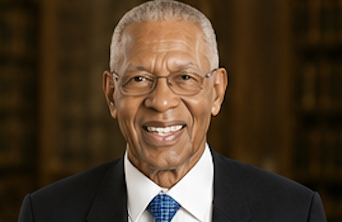
Reverend William A. Lawson
Reverend William A. “Bill” Lawson (1928–2024), affectionately known as “Houston’s Pastor,” was a minister, educator, civil rights leader, and champion for social justice whose life was devoted to building bridges and strengthening communities. Lawson was born on June 28, 1928, to William Lawson Sr. and Clarisse Riggs. His parents divorced when he was a toddler, and he was later adopted by his mother’s second husband, Walter Cade, gaining three siblings: Walter Cade Jr., Catherine, and Joe Williams. Raised in Kansas City, Lawson graduated from Sumner High School in 1946. During his formative years, Lawson dreamed of becoming a cartoonist and expressed his creativity by painting a mural at English Street Baptist Church. He also began imagining himself as a preacher, a calling that surprised him because he had a tendency to stutter and no one in his family was a minister.
Lawson earned a bachelor’s degree in sociology from Tennessee A&I State University (now Tennessee State University) in 1950 and continued his education at Central Baptist Theological Seminary in Kansas City while serving as pastor of Mount Hebron Baptist Church in Pittsburg, Kansas. During this time, Audrey Hoffman, a student at Tennessee A&I, decided to write to Lawson after learning that women in her dormitory were corresponding with him. He responded, beginning an extraordinary two-year courtship by correspondence that included approximately 600 letters. When they met in person for the first time in Audrey’s hometown of St. Louis, she was wearing a bright red corduroy suit, inspiring Lawson to affectionately nickname her “Little Red.” The couple married on January 30, 1954.
In 1955, Lawson graduated from Central Baptist Theological Seminary with a Bachelor of Divinity degree, majoring in New Testament interpretation, and a Master of Theology degree. That same year, he was invited to Houston, Texas to become a professor of Bible Studies and Director of the Baptist Student Union at Texas Southern University (TSU). Lawson and Audrey moved to Houston with their young daughter, Melanie, beginning a remarkable relationship with the city that would span nearly seven decades.
Lawson’s involvement in Houston’s Civil Rights Movement began in 1960 when several of his TSU students approached him and Audrey about organizing lunch counter sit ins inspired by the student movement in Greensboro, North Carolina. Lawson initially urged them to focus on school rather than become involved, but the students respectfully declined his advice. Unsure of what to do next, Lawson turned to Audrey, who told him he needed to raise money to get the students out of jail if they were arrested. The exchange marked a turning point for Lawson, helping spark his commitment to civil rights and beginning decades of advocacy for equality and justice.
As Houston confronted the growing demand for desegregation, Lawson was invited to participate in a meeting of city leaders at the Rice Hotel. He entered through the back of the hotel and rode a freight elevator, illustrating the very discrimination and barriers African Americans were seeking to overcome. The negotiations contributed to a coordinated decision to integrate approximately 70 Houston lunch counters on August 25, 1960. “Whites Only” signs were removed, expanding access to African Americans throughout Houston and marking a significant step toward desegregating the city.
In 1962, Lawson and Audrey welcomed 13 people into their home, where they gathered to establish Wheeler Avenue Baptist Church near Texas Southern University. Lawson’s commitment to social justice also deepened as he became increasingly involved in Houston’s desegregation efforts. He established a local office of the Southern Christian Leadership Conference and developed a close friendship with Dr. Martin Luther King Jr. On May 10, 1965, Lawson helped lead thousands of African American students from Houston’s five African American high schools in a demonstration challenging the slow pace of school integration.
As Wheeler Avenue Baptist Church became a stronger presence in the community, Lawson transitioned from his formal role at Texas Southern University to devote more time to the congregation and his broader community work. His commitment to education remained strong, and he continued contributing to TSU by helping establish its first African American Studies program.
Throughout his life, Lawson dedicated himself to building bridges between the powerful and the powerless. In 1996, his family and the Houston community established the William A. Lawson Institute for Peace and Prosperity (WALIPP) to continue that mission and advance opportunities for individuals and communities.
After serving as pastor of Wheeler Avenue Baptist Church for 42 years, Lawson retired in 2004 and became its Founding Pastor Emeritus. His retirement from the pulpit did not end his commitment to service. He continued advocating for racial equality, education, affordable housing, support for the homeless, and opportunities for underserved communities.
Among Lawson’s most enduring relationships was his extraordinary friendship with Archbishop Joseph A. Fiorenza and Rabbi Samuel E. Karff. Affectionately known as “The Three Amigos,” the three faith leaders shared a remarkable friendship that reached across faith traditions, racial differences, and backgrounds. United by a commitment to compassion, justice, and service, they worked together to address homelessness, poverty, racism, inequality, and other challenges affecting Houston. In 1993, Fiorenza and Lawson received the first NAACP Unity Awards in recognition of their work on behalf of Houston’s homeless and poor. Alongside Karff, their collective leadership reflected a broader commitment to bringing people together in service to the community. The enduring friendship of The Three Amigos became a powerful example of how faith, friendship, and service can unite people, inspire action, and create lasting change.
Lawson was also an author, publishing Lawson’s Leaves of Love, and his lifetime of service earned numerous honors. He received honorary doctorates from Howard Payne University, the University of Houston, and Texas Southern University. The University of Houston established the William Alexander Lawson Social Justice Scholarship Endowment, Rice University honored him with the Stephen L. Klineberg Award, and a portion of Rice University’s central quadrangle was named the Reverend William A. Lawson Grove in his honor.
Reverend Lawson was a devoted husband, father, grandfather, great-grandfather, preacher, professor, civil rights leader, mentor, and friend. He and Audrey shared a remarkable 61-year partnership until her passing in 2015 and together raised four children: Melanie, Cheryl, Eric, and Roxanne. Their family grew to include two grandchildren, Robyn and Raven Troup, and two great-grandchildren, Amadeus and Ronin Koby. Yet among the many titles used to describe him, one captured his extraordinary relationship with the community he served for generations: “Houston’s Pastor.” His legacy of faith, courage, education, justice, and service continues through the institutions he helped build, the lives he touched, and the generations inspired by his example.